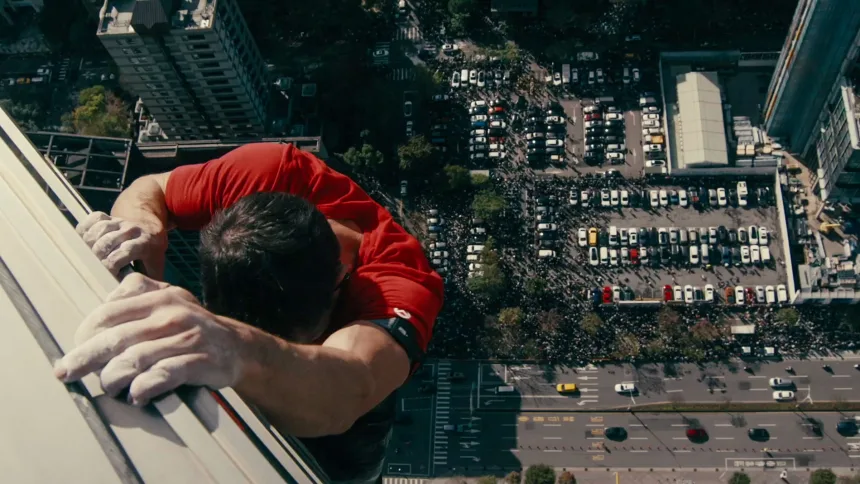
TAIPEI, Taiwan — American rock climber Alex Honnold scaled one of Asia's tallest skyscrapers without ropes or safety equipment Sunday, fulfilling a decade-long ambition in a feat broadcast live to a global audience.
Honnold, 40, the subject of the 2019 Oscar-winning documentary "Free Solo," conquered the 508-meter Taipei 101 using only his hands. Netflix streamed the 91-minute ascent of the 101-story building worldwide as part of its "Skyscraper Live" program.
Crowds cheered as the climber began his journey and again when he finished, waving to spectators from the summit.
The event sparked backlash from some members of the climbing community and media, who questioned the ethics of livestreaming such a high-stakes endeavor. Critics called the broadcast "irresponsible and morbidly curious," pointing to the high mortality rate of free soloing and Honnold’s personal life as a husband and father.
Taiwanese President Lai Ching-te congratulated Honnold, noting that the broadcast allowed the world to see Taiwan through a different lens beyond its typical associations with semiconductors or military tensions.
Analysis
Alex Honnold’s ascent of Taipei 101 marks a calculated strategic pivot for Netflix, signaling the streaming giant’s aggressive expansion into live sports entertainment. By positioning Honnold not merely as an athlete but as the centerpiece of a global media event, Netflix is attempting to bridge the gap between documentary storytelling and high-stakes spectacle. The initiative reflects a broader industry trend where digital platforms seek to manufacture "appointment viewing" moments, aiming to capture the massive, synchronized audiences traditionally reserved for legacy broadcasts like the Super Bowl.
For Taipei, the event served as a sophisticated soft-power maneuver. President Lai Ching-te framed the climb as an opportunity to project a positive international image, offering a counter-narrative to the prevailing headlines dominated by cross-strait geopolitical tensions and semiconductor supply chain dominance. By facilitating the production, the Taipei city government and Taipei 101 management demonstrated a keen understanding of "event diplomacy," rebranding the capital as a modern, open, and culturally vibrant global hub.
However, the broadcast raises significant ethical questions regarding corporate social responsibility. The decision to live-stream an activity with a high probability of a fatal outcome forces a confrontation between commercial incentives and ethical broadcasting standards. Critics argue that such programming risks commodifying extreme danger and exploiting audience voyeurism under the guise of celebrating human achievement. As streaming platforms increasingly lean into high-risk content to secure market share, the tension between honoring peak human performance and normalizing lethal risk for entertainment remains a central point of debate for media regulators and the public alike.
Bảo Nguyễn
Bảo Nguyễn founded Saigon Sentinel to give the Vietnamese diaspora truly independent, in-depth community coverage at a time when misinformation moves faster than fact-checks and the language barrier makes verification harder than it should be. He sets the editorial standards and quality controls that govern the reporting, chooses the subjects, writes and edits each article, reads it against its sources before publication, audits published output, and handles corrections.